
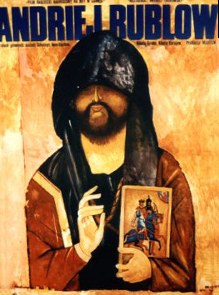
 Director: Andrei Tarkovsky
Writers: Andrei Konchalovsky, Andrei Tarkovsky
Release Date: 1971 (Soviet Union)
Awards: Cannes Film Festival 1969 (FIPRESCI Prize), French Syndicate of Cinema Critics 1971 (Critics Award Best Foreign Film), Jussi Awards 1973 (Jussi Foreign Film)
Runtime: Soviet Union:165 min (re-edited version) / Soviet Union:186 min (re-edited version) / UK:183 min (2004 re-release) / 205 min (original length) / UK:145 min (UK version)
Country: Soviet Union
Language: Russian / Italian / Tatar
Color: Black and White / Color
As the prologue to Tarkovsky’s film on the life and times of Russian iconographer Andrei Rublev draws to a close, there is a moment that perfectly encapsulates its underlying themes. A man lies helpless on the icy ground. At his side, dark against the pristine whiteness of the snow, lie the tattered remains of a primitive hot-air balloon. It deflates slowly, mirroring the final breaths of its master. Creator and created alike are the victims of an absurd ambition; man has tried to walk among the clouds, only to fall back once again to earth.
Strangely, we never learn the identity of this man. But just as the maddeningly deliberate camera movements and casual, off-hand depiction of suffering serve as a harbinger of things to come, so too does this scene serve as the ultimate paradigm for the events that follow. The question raised by this image is repeated time and again throughout the film, and in no clearer distillation than in the struggles of the title character.
The film is divided into a prologue, epilogue, and seven “chapters.” This structure suggests a traditional storyline of some sort, but Tarkovsky makes every effort to avoid such clear distinctions. The film's numerous flashbacks often give no clues as to where they fit temporally. Andrei Rublev himself is only occasionally the central figure; in fact, several of the secondary characters receive much closer scrutiny. Yet his presence looms large, serving as a reference point amidst the confusing puzzle of events.
As the film opens, Rublev and his two monastic companions take shelter from a sudden storm in a small, dilapidated barn. They find themselves in the company of several peasants and a jester, who amuses his cohorts by performing comedic routines for them, including several that openly ridicule the friars. One of the three monks, known only as Kiril, points the jester out to local authorities, who brutally beat him for his insolence.
Andrei and his friends make their way to the monastery at Andronikov. Soon after their arrival, he is summoned by the Grand Prince to assist Theophanes – an iconographer of immense artistic and spiritual stature – in painting the Cathedral of the Annunciation in Moscow. Together, they struggle to understand the impact of their work, and to recognize the role of an artist in society.
After completing his studies under Theophanes, Andrei travels to Vladimir on commission from the Grand Prince. Breaking away from his followers, he watches as the local pagans engage in a night of unbridled lust and baffling ceremonies. Upon being captured by the pagans, he is confronted by a beautiful sorceress, who tests his vows and beliefs before helping him to escape.
When Andrei reaches the chapel in Vladimir, he finds himself unable to paint the traditional icons of his original commission. Instructed to depict the Last Judgment, he refuses to paint something so clearly intended to terrify. The entrance of a feeble-minded woman, Durochka, underscores his conflict. Inspired by her innocence, he chooses to represent the Last Judgment as a feast, rather than a tribunal.
Meanwhile, external political matters become increasingly urgent. The Grand Prince’s jealous younger brother brokers an agreement with the enemy Cossacks, and moves on Vladimir. Virtually unopposed, the invaders sweep through the city. The defenseless villagers barricade themselves in the newly completed chapel, but earn only a momentary respite. As the attackers begin to systematically rape, torture, and murder all unfortunate enough to survive, Andrei kills one of the Cossacks marauders attacking Durochka.
Miraculously, both survive the raid, but Rublev is appalled by the crime he has committed. He vows to never paint or speak again, in an effort to atone for what he sees as a grave sin. Accompanied by Durochka, who serves him as a constant reminder of his offense, Andrei returns to Andronikov. There he encounters Kirill, his early companion, who pleads with him to resume painting. But Andrei is resolute; nothing will convince him to again take up his art.
Some years later, Andrei makes his way to Kiev. There, the Grand Prince marshals his resources and his workmen in an effort to create a massive bell. The entire project is supervised by a young boy who works tirelessly on every detail of the founding. Unbeknownst to his superiors and subordinates alike, he has no idea how to cast a bell of this size, but proceeds on faith and effort alone. After months of backbreaking work, the new bell is completed and rings out for the first time. As it sounds, Andrei is dramatically altered, and vows once again to take up his art for the greater glory of God.
Throughout this journey of trial and redemption, Tarkovsky weaves many seemingly unrelated threads. The complex, disconnected style of the film is reminiscent of another Russian master: Leo Tolstoy. Like Tolstoy’s magnum opus, War and Peace, Tarkovsky’s film is a sprawling epic and an incredibly ambitious work. Like Tolstoy, he makes use of shifting story lines and seemingly incidental characters, all anchored by a central theme. And perhaps most like Tolstoy, his film works much better when he allows the protagonists to act out this theme rather than talk about it. But what is this theme?
The answer to this question lies in the now clearly essential opening prologue. There, we see the tragic result of a man’s efforts to create. But we also see the moments of glory that accompany that tragedy; the two go hand in hand. In Tarkovsky’s eyes, art is a creation wrung from the very being of the artist. It is this investigation and understanding of art that drives the film. Both Rublev and Tarkovksy seek to comprehend art in its very essence. Both struggle to understand how an artist relates to his historical surroundings, his fellow humans, and perhaps most importantly, his divine audience.
The fact that the title character and Tarkovsky share the same name cannot be a coincidence. Indeed, the director struggles with many of the same issues that plague his protagonist. Like Rublev, he experiences periods of sterility and self-doubt. Like Rublev, he finds what he seeks, though not without great effort. And again like Rublev, Tarkovsky is unsure of his focus in the early going. The first scenes, in particular, are bogged down in philosophical language where the characters seem to be speaking more to the audience than to one another. This, combined with Tarkovsky’s particularly deliberate style, can make the film’s initial sections difficult.
As the narrative progresses, it grows surer of itself. Rather than using his characters as mouth-pieces for his philosophies, Tarkovksy begins to let their actions speak for themselves. In particular, the film seems to take a drastic step forward with the Raid of Vladimir. Tarkovksy’s long takes and deliberate pacing are a constant; every shot is perfectly composed, and every sequence has a poetic, mesmerizing tempo. But the raid sequence introduces something new to the equation: rapid, dramatic action. The combination is dynamic, and from this point on the film builds steadily. Tarkovsky has found his creative voice. (Interestingly, it occurs just as Rublev himself falls silent.)
The Raid is one of the finest set pieces ever put to celluloid. But Tarkovsky follows it up with an even greater piece: the forging and ringing of the giant bell. As it tolls out over the countryside, the young bell smith realizes he has created something truly extraordinary; he has succeeded beyond his wildest expectations. In this moment, Tarkovsky provides the answer to his protagonist’s (and his own) most pressing question. The incredible dedication and sacrifice for the sake of his creation inspires the monk and director alike. Andrei remembers why it is that he used to paint, and more importantly, why he must paint again.
Prior to the epilogue, the film is stark, shot in high-contrast black and white. But as Rublev rediscovers his art, the audience is bombarded with spectacular colors. In this epilogue, Tarkovsky introduces the crowning achievements of Andrei Rublev’s career in an almost experimental format. The colors are brilliant, the music powerful, and the images mesmerizing. Above all, this final segment is a tribute to Rublev the artist.
Tarkovsky explores - through Rublev’s own trials and the trials of others - the power and sacrifice that accompanies every artist. One might object to various aspects of the film – (such as its historical inaccuracies, its casual brutality, its tendency to philosophize, or its difficult style) – but if those can be overcome, there is no denying its power. Tarkovsky, like Rublev, has undergone a transformation. He has come to understand clearly why he is compelled to create. And in so doing, he has produced a true work of art.
©Joseph Susanka

15 July 2007
Andrey Rublyov (1969)

Subscribe to:
Post Comments (Atom)


0 comments:
Post a Comment